Saturday, 15 May 2021

Night light


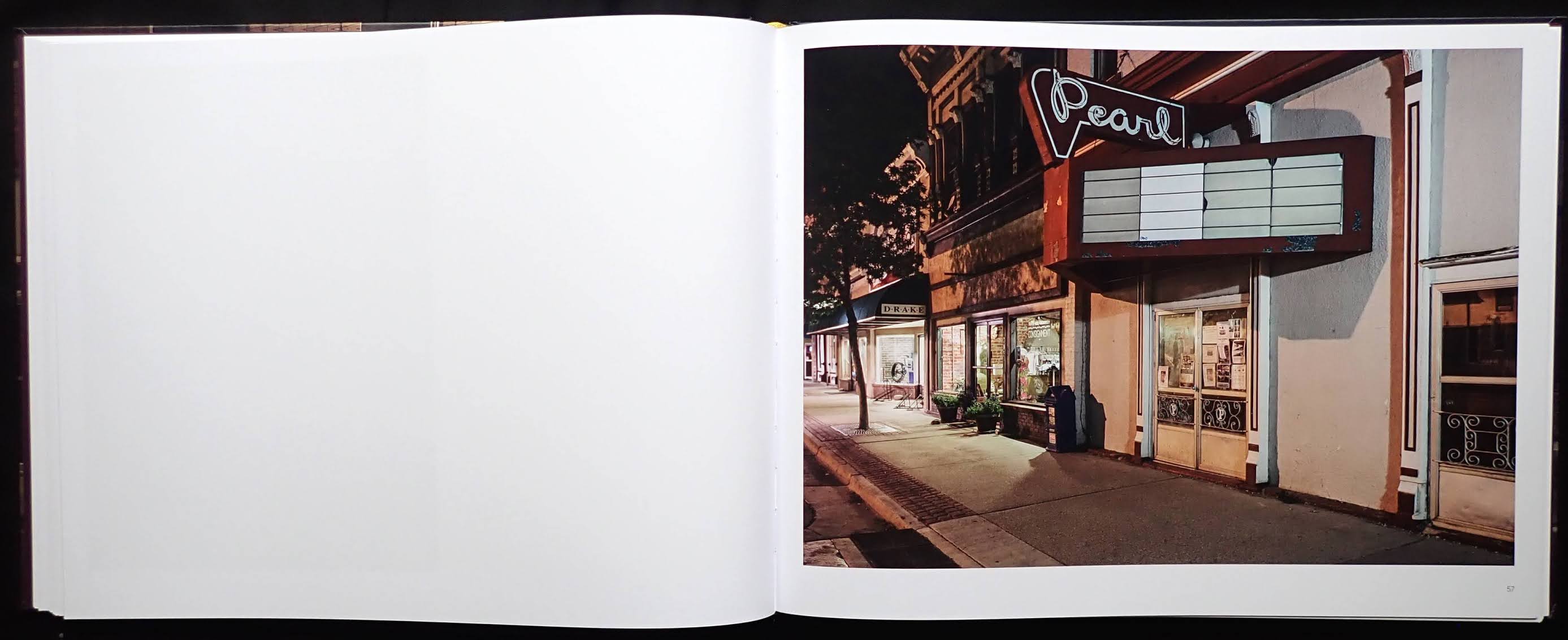
Daniel Freeman follows the well-trodden path of photographing American commonplace but with his own unique take by capturing small town Main Street at night.  None of the seventy-eight photos, all taken since 2010, have a location caption so this makes the book a good visual survey of what small town USA looks like after dark without pedestrians and traffic. 

Actually Main Street is alive with colour and detail because there is so much light from shopfronts, street lights and the occasional traffic light. The amount of detail in those photos is amazing, it might be night but there is enough light to reveal the architecture of buildings fading into the dark sky and at pavement level shops and eating places clearly reveal what's inside. I thought the photos that worked best are those taken across the street so the various retail units become a  left to right strip or taken diagonally at a street corner with the buildings fading away in perspective. For a change of pace from Main Street, there are some photos of abandoned gas stations and vehicles. 

There is one thing that really enhances this photobook: the paper and printing. The back of the book imprint page says the paper is Magno Satin, which is a silky smooth matt art paper, perfect for printing with a very fine screen (I'm guessing 300) to bring out all the precise detail Freeman captures with his camera. 


Wednesday, 12 May 2021

The art of fifties romance


A very welcome addition to the earlier book Lifestyle Illustration of the 60s. This latest one follows the same format as the 60s with over 1300 illustrations and almost all of them in color. All the work is from women's magazine romantic fiction and I find it amazing that more than a hundred artists manage to find so many creative ways to show essentially the same thing: the emotional reaction between a man and a woman.

Like the 60s book, the artists are British or American though there are a few contributions from continental Europe, Danish Kurt Ard has several paintings included. The prolific Coby Whitmore has the most in the book, more than fifty, all revealing what a brilliant artist he is, especially his compositions. Eric Earnshaw and Harry Hants together have more than eighty between them. Hants did a lot of covers for the British 'John Bull' weekly magazine, easy to spot as you go through the book because they are complete squared-up cover paintings. Other artists that have a good showing include Joe Bowler, Lynn Buckham, Joe DeMers, Gerry Fancett, Francis Marshall, Edwin Phillips, Andy Virgil, Jon Whitcomb and Walter Wyles but only one from my favorite (apart from Whitmore) Bernie Fuchs, he had a better showing in the 60s book.

It's interesting looking through both books to notice a change of technique between the two decades. In the 60s book, the brush style is much freer and casual, the compositions are more flexible with different points-of-view which is not seen so much in the 50s illustrations. There is a use of much more vibrant colors in the 50s work which by the 60s had merged into lots of red, orange and brown as the dominant colors.

Both books show the best romantic fiction illustration by masters of the genre, a wonderful visual and nostalgic look at a vanished art form. 

The art of sixties romance


How amazing to come across a book that I could never imagine would be published but here it is. Over a thousand illustrations from American and British artists used to illustrate romantic fiction in women's weekly and monthly magazines. They all come from weekly or monthly titles of the sixties and you might think, that inherently, the visual format is rather restrictive and it's true that much of the art is similar but these artist's compositions and paint techniques are varied enough to provide interest page after page.

Having worked in magazine publishing back then I was familiar with many of these great illustrators. I was a big fan of Bernie Fuchs and David Roach mentions in his intro that Al Parker was a great influence in the forties and fifties (especially with his mother and daughter paintings for the covers of the Ladies' Home Journal) and Fuchs was a similar inspiration for many illustrators in the sixties, he gets ten works in the book with a stunning spread on pages 326-327.

I estimate the book has the work of over two hundred illustrators and plenty from unnamed artists. Lynn Buckham has the most then good showings for Joe Bowler, Joe DeMers, Eric Earnshaw, Frank Haseler, Michael Johnson, Brian Sanders, Herb Tauss, Andy Virgil, Coby Whitmore and Walter Wyles. Oddly the great Austin Briggs only gets one. There are several illustrations from teenage weeklies that I would have left out. They are uncredited fashion and spot illustrations of no particular merit, especially when compared to the artists whose work fill up most of these pages.

The book's production is excellent and very similar to the Taschen thick, chunky softcover titles (in fact Taschen published the Fiell's Decorative Art series). The back pages have an artist index and twenty-four get short biogs. My only criticism is that a light drop shadow on two sides of all the oblong illustrations would have given them a lift on the page.

There is a companion book with the same art from the fifties and together with this sixties book a whole collection of wonderful artists can be rediscovered.


Thursday, 6 May 2021

An unknown photographer whose work was everywhere


A quite an amazing book about photographer Paul Wolff and his partner Alfred Tritschler. Wolff was born in southwestern Germany in 1887 (he died in 1951) and took up photography professionally in his twenties. He met Tritschler, who had a Master of Photography degree which was required to open a photo studio and Dr Wolff & Tritschler was born. Their work was used in a whole range of publications, especially corporate work for large German companies, showing their factories and how products were made. In 1926 Wolff won a Leica in a competition and used various versions for the rest of his life, it helped being a friend of Oskar Barnack, the inventor of the small hand-held camera.

The author makes the point that Wolff produced a staggering amount of work during his career yet his name wouldn't appear on any list of the most important European photographers during the first half of the last century. Museums would have prints by Renger-Patzsch, E O Hoppe, August Sanders, Karl Blossfeld, or Andreas Feininger but until recently nothing by Wolff. Fortunately over 500,000 Leica negatives of his work have survived. 

The book methodically traces the output of this remarkable photographer with his work for company promotional material, posters, postcards, trade and consumer magazine for covers and inside reportage, ads, travel brochures and calendars. Page 131 has four spreads from a brochure for bathing suits. He contributed to books about travel, animals and photography. Reading this book intrigued me so much I bought a copy of Wolff's 1952 book My experiences in color photography.

But wait, there's more. On page 578 begins a chapter on photographer Paul Wolff of Dresden (1876-1947). With two photographers doing similar work, especially German travel photography, so the book's Paul Wolff, in 1924, added Dr. in front of his name to avoid confusion between publishers who bought work from both photographers. They are about a hundred examples of work from Dresden Wolff.

Steidl has excelled themselves with this remarkable book. There are 2980 images in the 600 pages, all with a slight drop-shadow to lift them off the page and printed with a 175 screen.  Like Manfred Harting's other titles on photobooks Wolff's work is shown as covers and spreads (and as a publication designer this format particularly interests me) so it's possible to see how publishers used the photos. Everything has comprehensive captions with reference to publisher, publication size, number of pages, print run, printer and more.

There is no separate bibliography of Wolff's work in the back pages, the whole book sets out to do that.