Monday, 1 August 2022

Reid's natural way to paint (5/5)


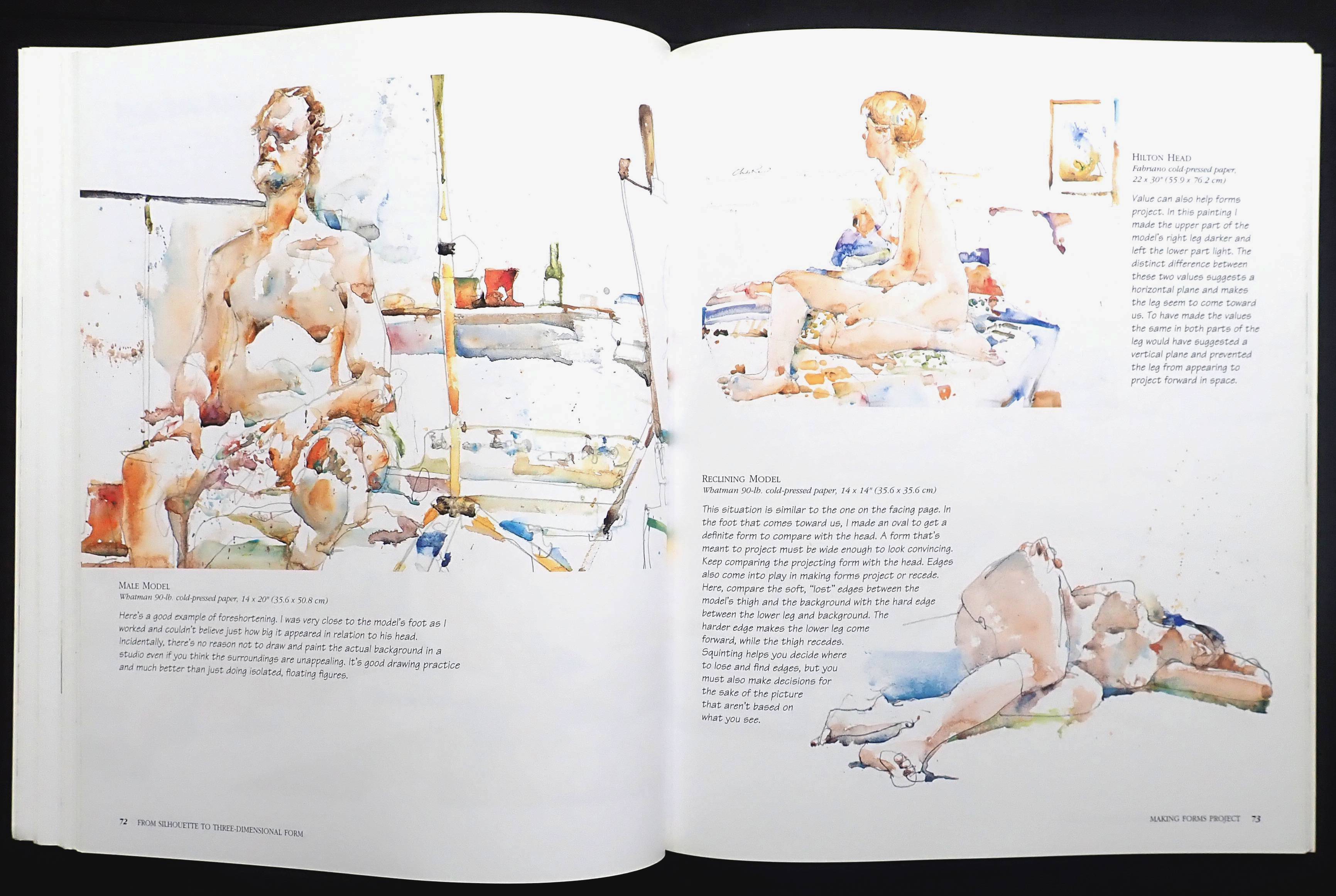
This is the sixth book I've got on my shelves by Charles Reid (1937-2019) and I must admit, as a publication designer, I don't have them to learn about painting, I just love his artistic style and with a couple of the books the excellent design though that was not his work. I can appreciate that not everyone is drawn to the very loose, casual way he creates paintings but I think this casualness is a useful guide for beginners.

Like any professional artist, he is a superb draughtsman. Pages forty and forty-one in the book is called Brushwork and it has eight pen and ink wash drawings of hands holding brushes, they just look perfect and the captions explain the various brushwork techniques. A significant feature of the book is how to draw and paint figures, either nude or clothed and how to handle facial features. Pages eighty-two and three have two watercolor paintings of figures revealing Reid's technique of merging colors together to create a dimensional feel to various parts of the body.

The text provides lots of interesting points. Page one hundred and twelve has a casual nude of Susan laying down and seen from the back, there's plenty of white space in the work and Reid says: "The biggest problem with finishing a painting is the wish to make it just a bit better, to add just a bit more. Here, I left a lot of white paper because I didn't know what to put in. If you don't know what to add, don't add anything." 

With Reid's stunning art and worthwhile comments, I think any beginner can get a lot out of this book.

Saturday, 30 July 2022

House Beautiful treasury of contemporary American homes / 1958 (5/5)


I recently reviewed a 1951 book of houses that originally appeared in monthly McCall's magazine, this book, from 1958, follows the same format: color photos of thirty-two houses that appeared in House Beautiful magazine between 1949 and 1958. The hundred and fifty photos are the same size as they appeared in the monthly, making this quite a large book (over thirteen by ten inches). Though both books feature contemporary houses more than half in the McCall's book were beautifully made models or room sets photographed in a studio, this book features real homes across America.

Each house has been architect designed though none of them are what might be called mid-century modern. They do have a feature of that style with interiors that are open plan and the ones in the southern states and California have extensive glass windows that can be opened to bring the outside inside. Very readable floor plans combined with text and photos to give a comprehensive impression of each house. You can still find reasonable copies on the net.


Friday, 29 July 2022

Lens ladies (5/5)


A timely book to re-balance the important contribution that women gave to photography. Marie Robert in her front-of-book essay mentions Constance Talbot who helped her husband William Fox Talbot, one of the early pioneers and she probably helped to create one of the first photo images, but she's forgotten now. The new world of photography from about the middle of the eighteenth century was considered a male-dominated art yet the first few pages of this book reveal plenty of work by women. 

Anna Atkins, 1799-1871, produced the first photo book using the cyanotype process in 1843 (her 'Blue Prints' is still in print today) Julia Margaret Cameron, 1815-1878, was regarded at the time, as the leading photographer of Victorian celebrities, Signe Brander, 1869-1942, born in Finland took hundreds of photos of Helsinki, between 1907 and 1913. These are just three of the three hundred women photographers revealed in the book.  

I thought the format of the pages was excellent. Rather than produce an alphabetical listing the author's have let the birth date of each woman dictate the page sequence, this allows the various styles of work to be compared historically with photographers of the same period. Anna Atkins is the first entry and the last Iranian Newsha Tavakolian born in 1981. Each gets a page with a photo and a several hundred-word essay and nicely these are all written by women. To break up the book's format there are three Portfolio sections split between seventy additional photos. All the photos throughout the book have title and date captions.

Even though there are three hundred women photographers mentioned it's probably in the nature of this kind of publication that someone isn't included. I was surprised that Annie Leibovitz doesn't have a page, or Esther Bubley, Nina Leen and Sandy Skoglund.

This is an important book that will help anyone interested in photography to appreciate the creative contribution of so many women.