Tuesday, 19 April 2022

The way they were (5/5)


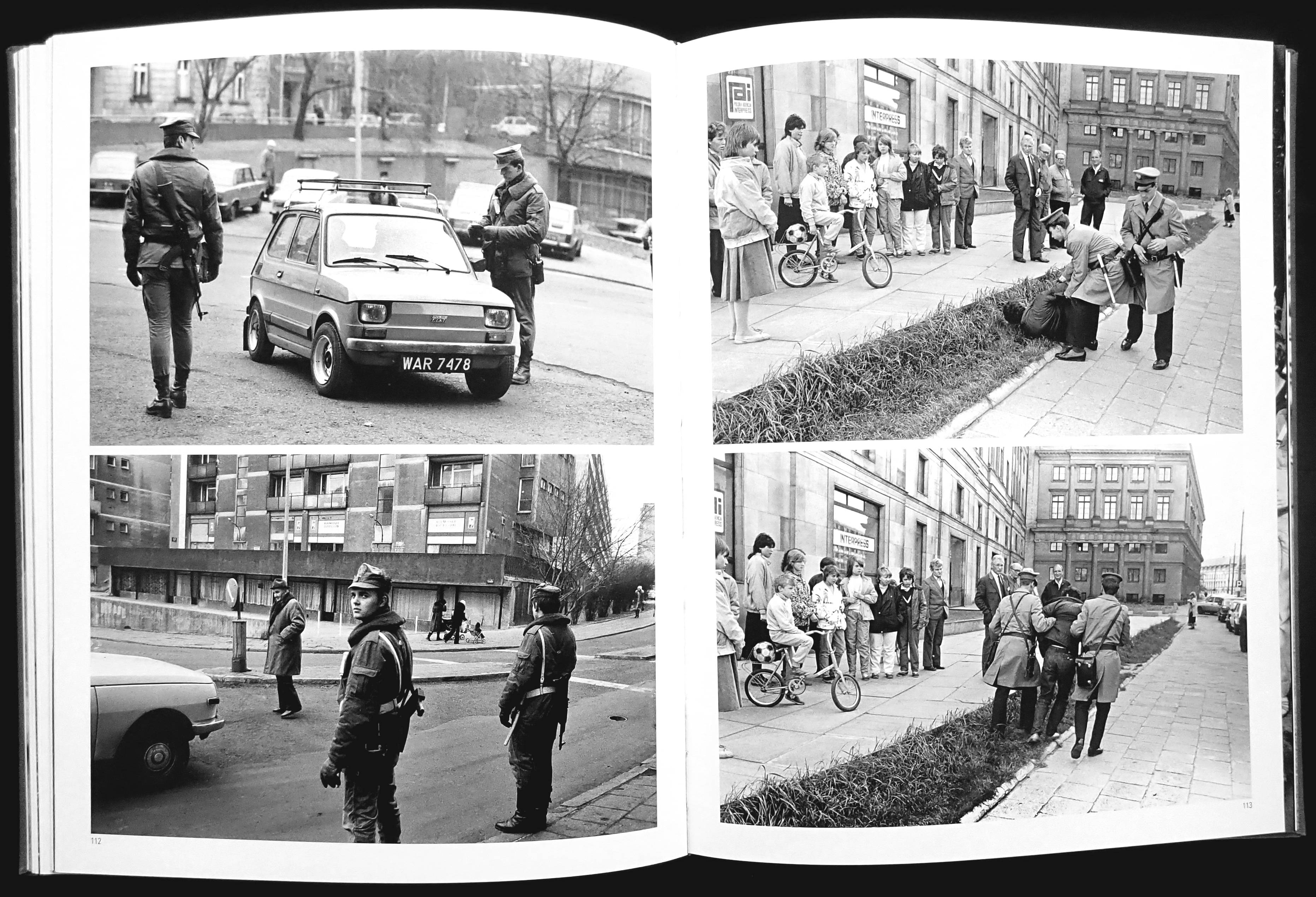
Grace is a well-known American photojournalist who carried out many assignments behind the Iron Curtain. Most of the fascinating photos in the book were taken in 1977 when he traveled through East Germany, Poland, Romania and the Soviet Union. Others were taken in 1982 and 1989. 

Despite being assigned an official minder by the authorities in various countries Grace managed to take some quite telling photos of everyday life that capture the feel of living in those ramshackle economies. Pages forty-six and seven has a spread photo of passers-by looking at a collection of large portraits of the best employees at a Yalta spa, page sixty-three shows a long queue of women outside a shop (in Eastern Europe it was always best to carry a bag and join any queue, someone could be selling something in short supply) page sixty-six shows a rural road in Poland, the only traffic are several farm horses pulling carts, page eighty-four has four vending machines selling drinks that only used shared glasses, page one hundred and fifty-six reveals a Warsaw flea market with some men selling foreign-made consumer electronics. 

It's the life of ordinary citizens revealed in these photos that give them credibility though I wonder if things have changed significantly in the last few decades, especially in rural areas of the old communist satellite countries. Grace managed to capture a past that is probably still lingering but minus the state security apparatus. One slight annoyance with the book is that nine of the back pages have thumbnails of the photos and captions. Nearly all the pages have space for the captions which would have avoided plenty of flipping the pages backward and forwards to read a caption.

Tuesday, 5 April 2022

Strange houses (5/5)


 A worthwhile monograph of the artistic work of Ian Strange. . He, along with Gregory Crewdson, James Casebere and Gordon Matta Clark use domestic housing as the focal point of their art, although Crewdson takes it further by creating elaborate tableaus with people in or outside a house.

The book considers seven multiple examples of Strange's work, from Suburban in 2011 up to 'Island' in 2015-2017. Iso started in 2016 is still ongoing and I thought the least interesting of his work as it's the nighttime street shots of Perth, Australia and Mountainside, New Jersey, USA. The six photos are dark and show very little except street lights. Final act from 2013 is much more fascinating. Four houses on one street were selected from 16,000 due to be demolished because of a severe earthquake in Christchurch, New Zealand during 2011. One house, in particular, looks intriguing because Strange removed a strip of the exterior wall right around the building, lit it from the inside and photographed it. Zloty from 2015 shows a building in Katowice, Poland with the exterior completely covered in golden wallpaper. It was on display for eleven months before being knocked down.

Strange's work exists only as photographs because he uses the exteriors of homes that are to be demolished. Three buildings in Cleveland and Akron, Ohio had their exteriors painted with black letters, SOS, HELP, or RUN, the height of the property.

The landscape book has three essays in the front with some back pages showing Strange and his crew preparing the houses. All of these pages are printed on matt stock. The 113 pages of photos are printed on a smooth art paper with an impressive 250 screen.


Thursday, 24 March 2022

The biggest (and best) book of Art Deco posters (5/5)


Above The cover without the jacket


This surely has to be the definitive book on Art Deco posters. With 340 in color and large on the page, I doubt if anyone will publish anything better, though as William Crouse says in a short essay about poster collecting it does not include movie, political and Russian ones.

The ten chapters in the book look at poster art around the world from 1919 to 1939. I think the best ones involve movement in some form: aviation; autos and racing; railways; liners. Speed seems the ideal subject to bring out the creative best using vibrant colors, strong graphic shapes and sans typography. It'll be no surprise that Cassandre has the most entries in the index -- thirty-one.

A thing that surprised me and it's really one of the strengths of the book is the very comprehensive captions. So, as well as large posters you can read a lot about the artist/designers and the companies that commissioned the work. The author really has done a huge amount of research to pull all this detail together and nicely, here and there, mono photos are included to tie in with what the text is saying.

The production is as impressive as the contents. A tip of the hat to book designer Russell Hassell who created a simple, elegant presentation that lets each poster work, clean typography too. The spread chapter openers are particularly attractive with each left-hand page using four upright strips, butted together, taken from posters in that chapter. A surprise was finding four fold-out pages, one of which has three beautiful Lester Beall posters created in 1936 for the Rural Electrification Administration.

As I've said already, I doubt there will be a better, more comprehensive book on Art Deco posters than this one.